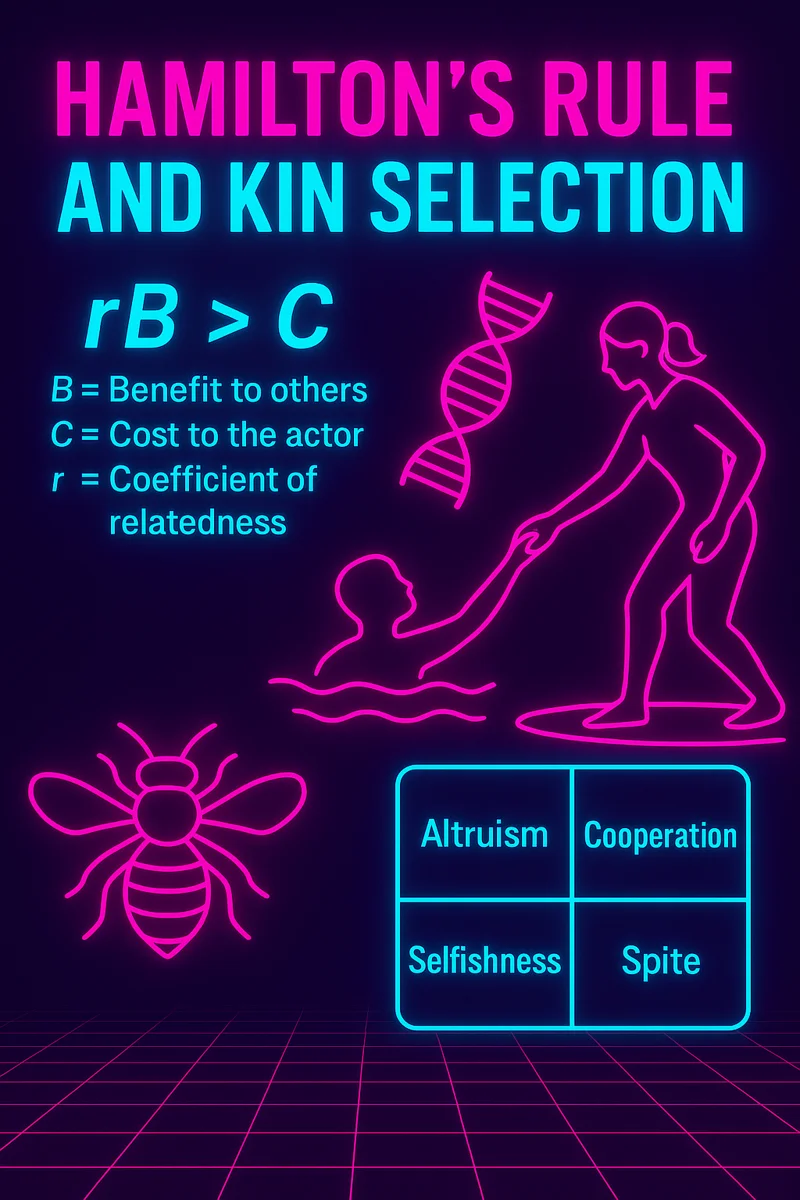
✦ In fact, this inequality describes the relationship among three factors:
B = Benefit to others
C = Cost to the actor
r = Coefficient of relatedness
This relationship is known as Hamilton’s rule, which can take three forms:
rB > C | rB < C | rB = C
Hamilton’s rule is central to evolutionary biology as it explains the concept of kin selection. This concept refers to a form of natural selection that favors altruistic behavior toward relatives because it increases the reproductive success of individuals who share one’s genes.
In general, natural selection favors altruism when:
rB ≥ C
✦ Example:
Suppose a woman sees her brother drowning and considers helping him. If her brother could potentially father 2 children, then the benefit (B) of saving him is 2 offspring. The coefficient of relatedness between a brother and sister is r = 0.5, so rB = 0.5 × 2 = 1.
Now, let’s consider the cost (C) to the sister: She faces a 0.25 probability (risk) of drowning while trying to save him. If she could also have 2 offspring, then her expected cost is: C = 0.25 × 2 = 0.5.
Thus, rB = 1 > C = 0.5. Since rB > C, Hamilton’s rule is satisfied, indicating that natural selection would favor this altruistic act!
✧˖° Learn More...
🦋
#Hamilton_Rule








No comments yet.